
-
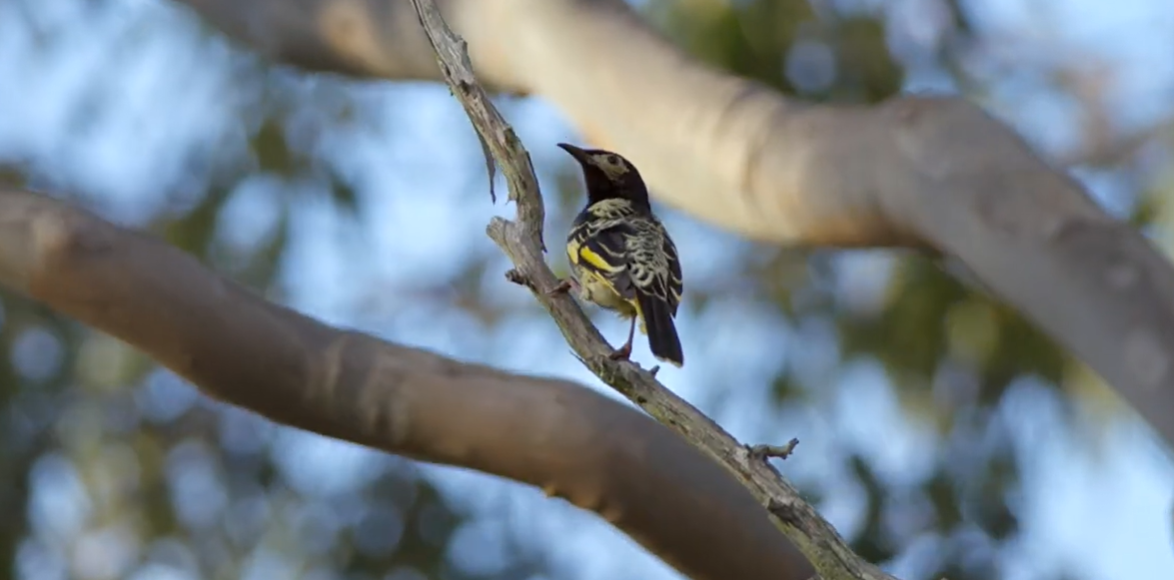
A black and yellow Regent Honeyeater, perched on a tree branch.

Zoo-bred regent honeyeaters spring release- where are they now?

  • Context: Regional

To boost the drastically small critically endangered regent honeyeater population – a record 69 zoo bred birds were released last October within the Tomalpin Woodlands in the Lower Hunter Valley on Wonnarua Country.

25 of the birds were fitted with tiny UHF transmitters so a radio-tracking team could monitor their movements.

Hunter Local Land Services (LLS) staff are members of the radio-tracking team led by BirdLife Australia, NSW DCCEEW, Mindaribba Local Aboriginal Land Council and the Australian National University.

With the breeding season now over, many of the zoo-bred and wild birds have now dispersed.

Hunter LLS staff, together with the other project partners, are continuing to monitor Regent Honeyeaters in and nearby the Tomalpin Woodlands to gain an understanding about their behaviour and distribution. This information will assist in managing and protecting both nesting and foraging habitats.

The community can support tracking of regent honeyeaters by reporting any sightings to BirdLife Australia here: https://birdlife.org.au/what-to-do-if-you-see-a-regent-honeyeater

Project funded by

This project is funded by the Australian Government Natural Heritage Trust and delivered by Hunter Local Land Service, a member of the Commonwealth Regional Delivery Partners panel.

Key observations from the regent honeyeater post-release monitoring (source BirdLife Australia):

  • In the first few days after they flew out of the holding tents, a cluster of up to 30 birds congregated along a major creekline feeding on flowering Forest Red Gum and Grey Ironbark. The tracking team were lucky enough to observe one of the first pairs constructing a nest.
  • A couple of birds left Tomalpin in the first few days but were eventually located in bushland near Kearsley where they were also constructing a nest. 
  • By the third week of post release, the familiar sound of two begging fledglings was heard in the Tomalpin Woodlands, raised by wild birds that the post-release monitoring located.
  • Zoo-bred females from this release also paired with wild males and/or zoo-bred males from the 2022 Tomalpin release., Also, for the first time a zoo-bred male (from 2022) paired with a wild female and managed to fledge at least two chicks.
  • Breeding was observed almost right up until the Christmas break, though upon the team’s return in early January we found birds had moved into “post-breeding” clusters. By early February more than 20 Regent Honeyeaters (including several juveniles) were found in these shady areas.
  • Post release monitoring is continuing as of February 2026 and excitingly, the team have fitted new radio transmitters to three birds, enabling the monitoring to continue hopefully into at least late March. 

Our regions our people

54 Regional NRM organisations work with people across the country - from the local to national level to manage our land, water, soil, plants and animals.

Secret Link