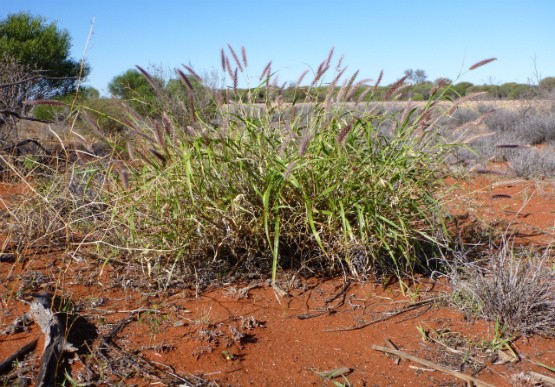
The paper discusses buffel grass as a serious threat in arid and semi-arid areas of Australia to social and economic values as well as the cultural practices of Aboriginal peoples of this region.
Buffel grass (Cenchrus ciliaris L.) is a globally significant invader now widespread across central Australia, but the threat this ecological transformer species poses to biodiversity, ecosystem function, and culture has received relatively little attention.
This paper suggests threats from buffel grass in arid and semi-arid areas of Australia are at least equivalent in magnitude to those posed by invasive animals and possibly higher, because unlike these more recognized threats, buffel has yet to occupy its potential distribution.
Buffel infestation also increases the intensity and frequency of wildfires that affect biodiversity, cultural pursuits, and productivity. We compare the logistical and financial challenges of creating and maintaining areas free of buffel for the protection of biodiversity and cultural values, with the creation and maintenance of refuges from introduced mammals or from large-scale fire in natural habitats. The scale and expense of projected buffel management costs highlight the urgent policy, research, and financing initiatives essential to safeguard threatened species, ecosystems, and cultural values of Aboriginal people in central Australia.