Stories of NRM partners
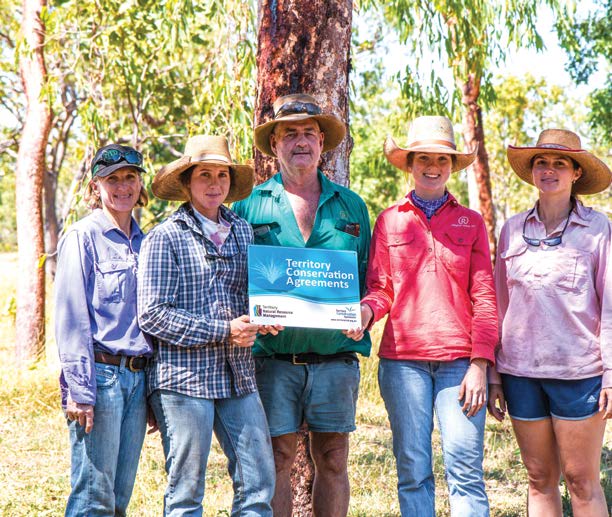
As one of the instigators of Territory Conservation Agreements in 2011, Alan Roe from Territory NRM appreciates a couple of anecdotes that illustrate the success of the constantly evolving project.

As one of the instigators of Territory Conservation Agreements in 2011, Alan Roe from Territory NRM appreciates a couple of anecdotes that illustrate the success of the constantly evolving project.
“It wasn’t a case of just doing it (TCA) because the money is available. Our owner thinks about the business being here for the next 100 years and that’s all based around being both profitable and sustainable.”
The strength of the agreements and a factor in their longevity is that they are voluntary, not registered under the title of the property and don’t assume that conservation is exclusive. Many TCAs allow for some level of grazing or stock access that is written into the plan.
More than 40 TCAs are now active with approximately 2–3 new agreements established each year through an expressions of interest program. Pastoralists meet at least half of the program cost and complete an annual report, with Territory NRM officers responsible for monitoring and measuring the sites using satellite information, sensor data and drones to map changes.
While 12% of pastoral leaseholds have TCAs across an area of 63,000 hectares of land with ecologically significant habitat, Alan says the sphere of influence is actually much wider because many pastoralists own or manage additional properties.
It’s also good for business. 88% of participants said they had a production increase as a result of the TCA, through improved pasture condition and water quality, strategic fencing and grazing, and feral pest control that encourages biodiversity and demonstrates sustainable management.
There’s great excitement amongst some of the original signatories about celebrating 10 years of achievement in 2021, Alan says, and it’s interesting to review the diverse sites that have been protected.
“The majority of our early TCAs were protecting wetlands and creeks on the grassland savannah of the Sturt Plateau, just south of Katherine, but over the years they’ve included Tipperary Station where there’s a rare vine rainforest, and a small island off Arnhem Land which is a very important turtle breeding site that’s managed with traditional owners,” he says.
“There’s a lot still to do. I would like to see a much higher proportion, 25–50% of pastoralists involved so that basic property management plans include the conservation of high value sites as a way of adding benefit to the business.
“But in ten years of the program we’ve never had anyone withdraw. We’ve planted a seed that might go on for 100 years!”
“But in ten years of the program we’ve never had anyone withdraw. We’ve planted a seed that might go on for 100 years!”
2018 Review of Territory Conservation Agreements – https://docs.wixstatic.com/ugd/da28f0_f49e157bedfd4775ab318aa1333fdc3e.pdf
Territory NRM Good Pastoral Business Report – A case for protecting native vetegation and biodiversity within the Territory beef industry
Territory NRM is proud to celebrate 10 years of non-binding Territory Conservation Agreements to protect high value sites, and will continue to encourage pastoralists to include TCAs in their basic property management plans.

Funded by the Australian Government National Landcare Program and Territory NRM.
Latest news and media releases